2025
Researcher, Designer,
Qualitative Interviewing, Quantitative Surveying, Prototyping, Wireframing, UX Writing.
UX research & interface design · Lund University / LTH, 2026
Synthesizers were built by engineers, and named accordingly. Oscillators, LFOs, filter cutoffs. When music production moved into software, those knobs and that vocabulary came along unchanged. Conventions matter; they're what make a design legible to people who've seen it before. But are mental models built for physical hardware actually well suited to making sound on a screen?
Ivan Illich argued that tools arrive in two phases: first they expand what people can do, then they institutionalise, and the conventions harden into requirements. I wanted to know whether synth interfaces had reached that second phase, and who gets left outside when they do.
What I did
I ran a mixed-methods study with four strands, so that no single source of evidence carried the argument alone.
Life-history interviews with two experienced producers, who structured the telling themselves. Since I have a long background in music production, a deliberately passive approach kept my assumptions out of the material.
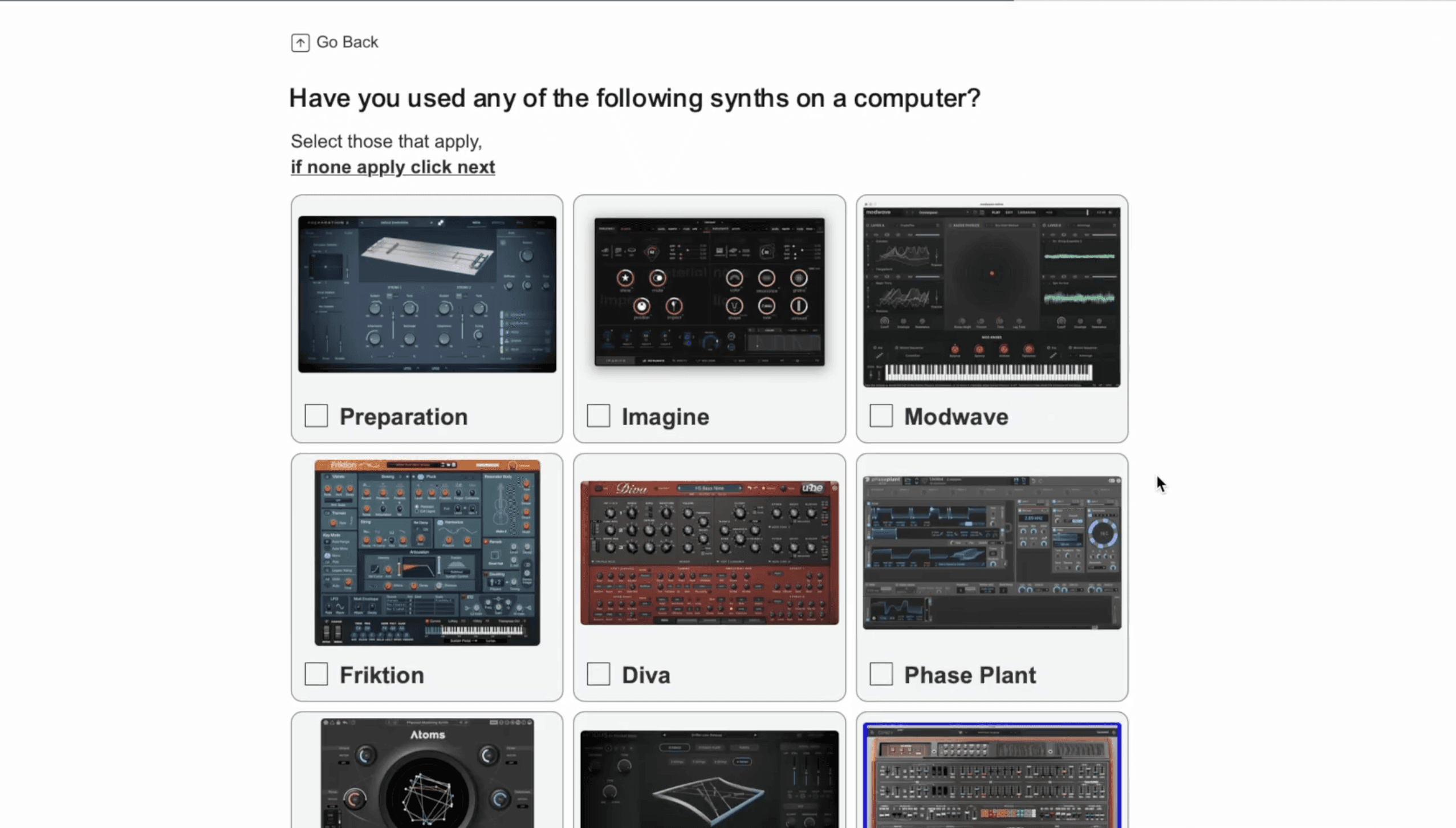
Think-aloud sessions with two people who had almost no production experience. They explored synths I had privately classified as conventional or unconventional, without being told which was which, and talked through what they thought each control was doing.
A survey of 74 producers, built on the Creativity Support Index, an instrument derived from NASA's Task Load Index that measures how well a tool supports open-ended creative work.
Design interviews, where I shared early sketches and asked people to interpret the interface back to me.
I also treated the survey itself as an accessibility problem. Asking people about cognitive load with a cognitively demanding questionnaire would have quietly excluded exactly the participants I most wanted to hear from. So I cut the repeated reliability items and the dimension-weighting section, chose the least abstract phrasing available for each dimension, replaced the original slider and its "highly agree / highly disagree" anchors with a five-point scale to reduce acquiescence bias, showed one question at a time, added a video guide, and offered machine translation. ISO 21801-1 gave me the framework for which accessibility dimensions to design against.
What I found
Conventional interfaces won consistently, on every dimension, with markedly lower variance. The largest gap of all was in time-sensitive work, where unconventional synths were seen as unreliable precisely because their results are unpredictable.
But the picture split along experience and age. Among participants under 40, and among those with less than fifteen years in production, unconventional interfaces scored higher on immersion and expressive capacity. And rating tracked usage frequency almost everywhere, the people who used a tool more liked it more, which raises an uncomfortable question about how much of the convention's advantage is design quality and how much is simple familiarity.
The think-aloud sessions were the most useful. Modulation was the recurring wall: newcomers would move an LFO control and hear nothing happen, because modulators produce no sound until they're routed somewhere. Skeuomorphism could actively hurt. Controls that mimic physical knobs are harder to operate with a mouse, not easier. And abbreviated technical labels were opaque. What people did appreciate, repeatedly, was animation: seeing the sound change as they moved something.
What I built
The two interface types turned out to serve different purposes rather than compete, so I stopped trying to replace one with the other and designed a bridge instead.
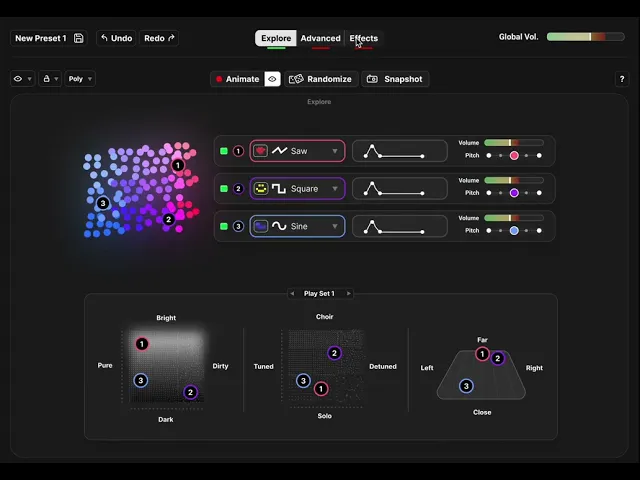
The result is a modular sound environment where the user switches parts of the interface on and off. An Explore mode lets you surf for sounds in a colour field and shape them in XY squares, a playful abstraction layer over macro controls, which can be the only thing you ever touch. Switch on the advanced modules and you get a conventional synth. Run both at once in a split view, and manipulating a control in one lights up its counterpart in the other, so that the playful layer becomes a way to learn the conventional one, rather than a substitute for it.
Modulation was rebuilt around a familiar mental model. Click record, pick a parameter, and define its movement on a timeline; closer to video editing than to patching. Modulated parameters then change colour and move in real time, so that the connection between the control and the sound is never invisible.

Iterations from user testing changed the specifics: "atonal/tonal" became "tuned/untuned", colour-coded sound modules became numbered ones after a participant pointed out that two different meanings of colour were competing, hovering a toggle now highlights the region it controls, and several components grew after a participant with a visual impairment found them hard to see.
The underlying position is that the user knows their own needs better than I do. The environment scales up and down accordingly. New ways in, without taking anything away from the people who like it as it is.