2026
Designer, Musician
Claude Coding, Specialized Hardware Implementation Research, Product Expertise
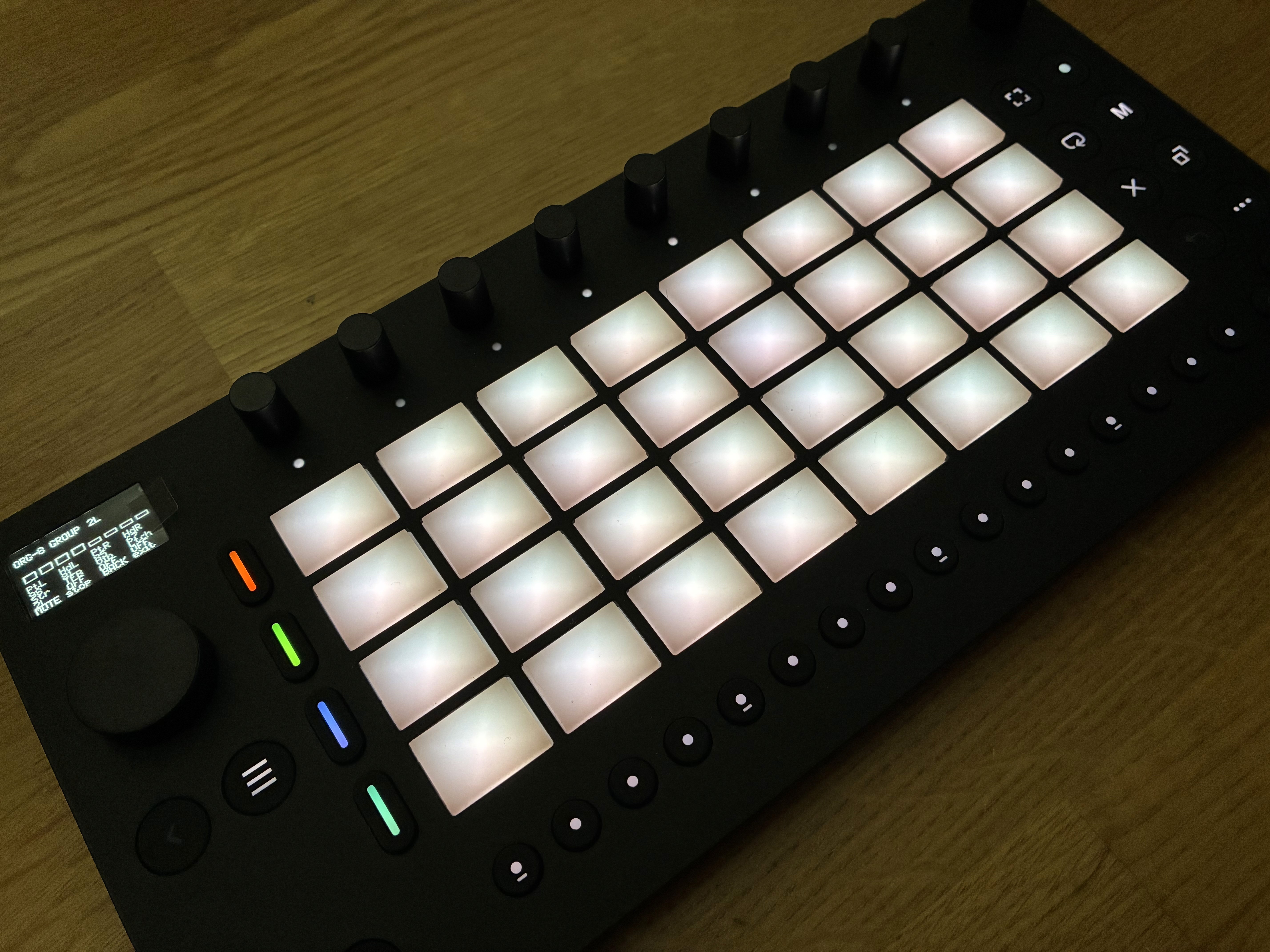
Porting an unportable instrument…
I wanted a LYRA-8 on my Move, which turned out to be a strange thing to want.
The LYRA-8 has no keyboard. Its eight voices are triggered by metal plates that respond to body capacitance, so how hard you press and how much of your finger touches it all change the sound. The oscillators sit in pairs that modulate and destabilise each other through feedback, which is what SOMA means by calling it "organismic." There are no presets. People record their settings to tape because a patch can be genuinely impossible to find again.
Ableton Move is a battery-powered groovebox with eight knobs, a grid of pads and a 128×64 monochrome screen. Nearly everything that makes the LYRA-8 what it is, Move cannot do.
What I had to decide
The question I kept coming back to was not how to fit the thing onto a small screen. It was which parts are actually the instrument, and which parts are just how it happened to get built.
The touch plates had to go, since Move's pads know nothing about body capacitance. But I decided the plates were never really the point. What they give you is a loose, imprecise gesture that resists playing in tune, and that behaviour can survive moving to a different input, as long as the response curve is shaped for expression rather than accuracy.
The feedback between voices was the opposite case. That is the instrument. If I had tidied it into eight predictable voices I would have ended up with something that matched the feature list and sounded nothing like it. So I kept the routing intact and built the interface around it rather than on top of it.
The one I went back and forth on was unrepeatability. A synth you cannot return to is awkward on a device built around saved Sets, but that same quality is where the character comes from. I landed on keeping the system unstable and giving myself a way to capture a moment I liked instead.
What made it hard
The screen, mostly. The LYRA-8's front panel shows you everything at once, and the layout is the documentation. On Move I get a few values at a time, so the spatial map had to become something you navigate without losing the sense of how the voices relate.
Schwung runs alongside Move's own firmware rather than replacing it, so the module had to share the device politely instead of taking it over.
And it runs on real hardware with real limits. Modules are native ARM64 binaries that get cross-compiled and pushed to the device over SSH. Eight modulating voices plus distortion and two delays is a lot to ask of a battery-powered chip in a sealed plastic box, so processing per block rather than per sample was a constraint I designed around from the start, and I spent time checking thermals and load on the device itself.
What I took from it
Designing for a hardware target as it actually is rather than as I would like it to be. Deciding what to keep and what to let go when an interface you love will not carry across. These were some of the important questions I had to grapple with when porting an instrument for a new hardware spec. Specifying and directing a native DSP build, then testing it on hardware. And getting comfortable working inside an undocumented community framework where the manual is other people's notes and the source code.