2020-2022
Composer, Producer
Digital DAW Production, Mixing, Mastering, Composition
Warm music for a cold place
Space has a sound and everyone already knows it. Cold pads, long reverb tails, everything vast and slow and faintly inhuman. Granted, it works. It's legible, it sets a scene in four seconds, and there's a reason every trailer in the genre reaches for it. So the obvious move when Solid Clouds brought me in to score Starborne: Frontiers was to write that, and write it well.
We didn't. And the reasoning behind that is the reason this project sits on a design site at all, because the call I made here is the same one I keep making in interface work: a convention exists because it solved something once, and the only question worth asking is whether it's still solving it for you.
How I got the job
A trailer, basically.
I wrote and produced the music for one of Solid Clouds' trailers. It found a much bigger audience than any of us expected, and that led to a conversation about what they were building next.
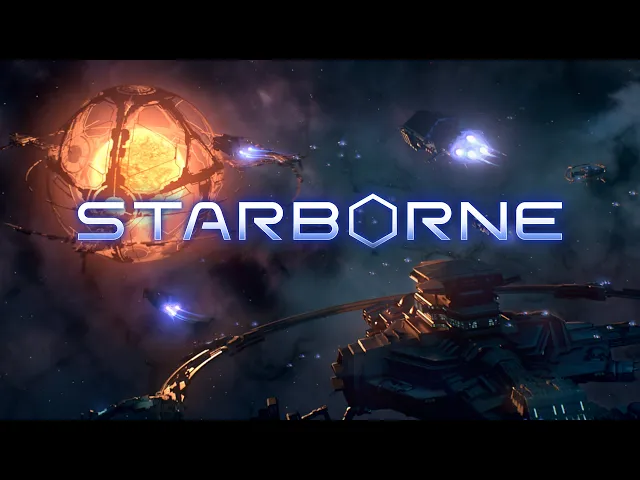
Solid Clouds is Icelandic, based in Reykjavík, and they've been building the Starborne universe since 2013. The first game, Sovereign Space, was a strategy MMO where hundreds of players shared one map and a round could run for weeks. Frontiers is a different animal entirely: a tactical autobattler with a story campaign, over a hundred ships, ninety-odd captains to recruit, ten factions with their own ethics. Same galaxy, completely different game.
The brief is the work
Before I wrote much of anything I spent a long time with the development team working out what kind of experience the game was aiming to deliver. By the time I understood what they wanted a player to feel, most of the musical decisions had already made themselves.
Because Frontiers isn't really a game about space. It's a game about who you take with you. You recruit captains in your starship base. You upgrade them. You read faction lore. The scale is cosmic, sure, but there is a distinctly human element that is worth tapping into.
So what does cold music do to that? It flattens it. It tells you the galaxy is enormous and indifferent and it says nothing at all about the part you're supposed to care about.
After experimenting with orchestral music in the first trailer, we did a complete 180 in the next, a choice that continued into the soundtrack for Frontiers. The score is organic, deliberately so, in a game set entirely in vacuum. Things in it breathe. You can hear bow noise, finger noise, tuning that isn't quite perfect. Against those visuals the contrast is the whole argument: the galaxy doesn't care about you and the music does.
Thirty minutes you can live inside
Then there's the constraint, which is where this stops being taste and starts being design.
A trailer gives you one shape and ninety seconds. You can see where the hit lands because it's right there in the cut. A game gives you none of that. Someone might sit in a menu for twenty minutes deciding on a formation, or lose the same campaign level six times because they keep sending the wrong ship in first. Music written around a single dramatic arc falls apart under that. It has to hold attention without asking for it, and it has to survive being heard far more often than you'd ever want it heard.
That's a usability problem wearing a different coat. The thing has to work on first contact and on the hundredth, for someone paying attention and for someone who isn't. For that reason I spent a very long time crafting the sonic palette to be neither anonymous, nor annoying; to contain interesting musical DNA that floats and weaves rather than having a beginning and an end. It's a delicate balance requiring a lot of testing.
What I'd take from it
The brief is the work, not the thing you do before the work. Those hours discussing the "feel" of Frontiers, produced better decisions than any amount of writing would have, because by the time I started I was solving the right problem rather than the obvious one. The organic direction was never a preference I brought with me. It fell out of understanding what the game wanted from a player.
And conventions deserve an actual argument, in either direction. Cold synth pads for space is a convention worth breaking here. Plenty of others are worth keeping, and knowing which is which is most of the job. I've since spent a thesis on the same question in synthesizer interfaces, where the conventions are knobs and technical labels rather than reverb tails, and the answer turned out to be roughly the same: work out what the convention was solving, then decide whether your users still need it solved that way.